

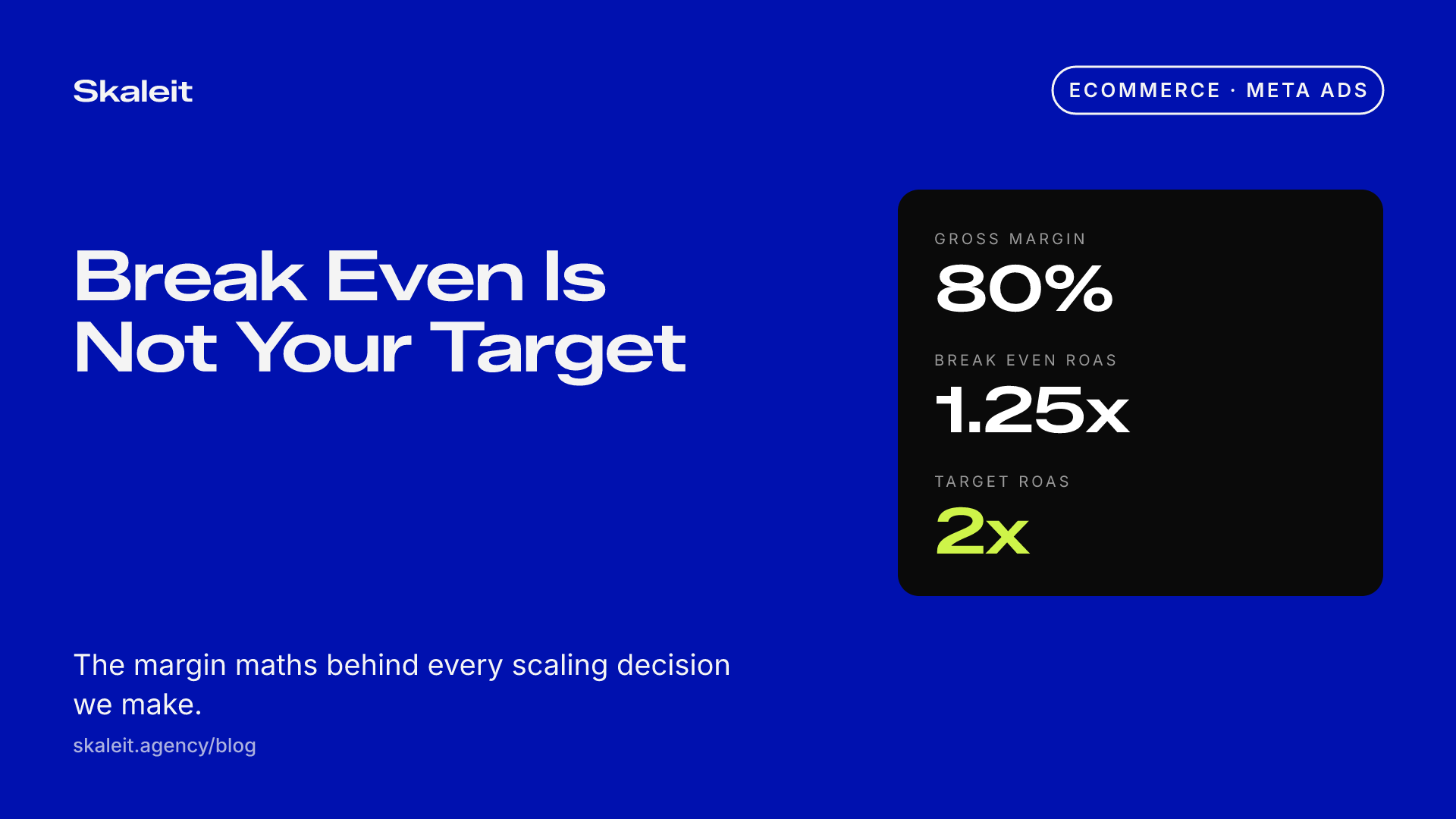
A break even ROAS calculator answers one question: at what return on ad spend (ROAS) do your Meta ads stop losing money? The formula is 1 divided by your gross margin. Sell a product for $100 that costs you $20 to make, your gross margin is 80%, and your break even ROAS is 1.25x. Below 1.25x you are buying revenue. Above it the order makes money.
The arithmetic is easy. What costs brands money is what they do with the number once they have it. Break even is a floor, not a goal, and the target you run the account against sits above it. This is the first calculation we run before we touch an ad account, and it sits underneath our framework for analysing Facebook ads to improve ROAS. Below is the formula, a margin table you can read your own number off, the spreadsheet version, and what the number changes once it exists.
TL;DR
- The formula: break even ROAS is 1 divided by your gross margin written as a decimal. An 80% margin gives 1.25x.
- Margin sets it, not price: two brands selling at the same price can have completely different break even points.
- Break even is not a target: subtract the profit you want from ads out of your gross margin first. 80% minus 30% leaves 50%, so the target ROAS is 2x.
- Operating costs move the floor: on an $80 product with $20 of cost of goods sold (COGS), break even cost per acquisition (CPA) falls from $60 to $50 once operating expenses are counted.
- Repeat purchase changes the answer: a brand that is happy to be profitable on the third order can pay $150 to acquire a customer instead of $50.
- The floor is not a kill rule: top of funnel ads sitting at 1.5x are often worth keeping, because they feed the sequence that closes at a higher return.
- Build it once: four inputs and two formulas in a spreadsheet, and every scale or kill decision in the account has a reference number.
What Break Even ROAS Actually Means
ROAS is revenue divided by ad spend. Break even ROAS is the value of that ratio where the gross profit on the orders exactly equals what you paid to get them. One dollar in, one dollar of profit back, nothing left.
It is expressed as a multiple because it scales with your margin, not with your price. If you keep 80 cents of every dollar of revenue, one dollar of ad spend needs to bring back $1.25 in revenue to produce 80 cents of profit. If you only keep 40 cents, that same dollar of ad spend needs $2.50 of revenue to do the same job. The price on the product is irrelevant on its own. What matters is the share of each sale that is still yours after the product is paid for.
This is also why comparing your ROAS to someone else on X or in a Facebook group tells you nothing. A 2.5x in a 40% margin business is break even. A 2.5x in an 80% margin business is a strong month.
How to Calculate Break Even ROAS
Four steps, and the only inputs are your selling price and what the product costs you.
- Take your selling price, or your average order value (AOV) if customers usually buy more than one item.
- Subtract your cost of goods sold to get the gross profit on the order.
- Divide that gross profit by the selling price to get your gross margin as a decimal.
- Divide 1 by that margin. The result is your break even ROAS.
Worked through with real figures: $20 in cost of goods sold on a product you sell for $100 leaves $80 of gross profit, which is a gross margin of 0.8, and 1 divided by 0.8 is 1.25. Your break even ROAS is 1.25x.
If you would rather read your number off a table than run the division, this is the same formula applied across the margins we see most often in ecommerce. The last column is the most you can pay to acquire a customer on a $100 order before the order stops being profitable.
| Gross margin | Break even ROAS | Break even CPA on a $100 order |
|---|---|---|
| 80% | 1.25x | $80 |
| 70% | 1.43x | $70 |
| 60% | 1.67x | $60 |
| 50% | 2.00x | $50 |
| 40% | 2.50x | $40 |
| 30% | 3.33x | $30 |
Thin margin brands live in the bottom half of that table, which is why a dropshipping account and a supplement brand can run the exact same ads and reach completely different conclusions about which ones are working.
Break Even ROAS vs Target ROAS
Break even is where you stop losing money. It is not where you want to operate, because a business that runs at break even on ads pays for its team, its software and its warehouse out of nothing.
So the target is calculated separately, and it starts from the same margin. Decide what share of revenue you want to keep as profit after ads. We usually work with 20% to 30% as of 2026. Subtract that from your gross margin, then divide 1 by what is left. With an 80% gross margin and a 30% profit target, you are left with 50%, and 1 divided by 0.5 is 2. The break even is still 1.25x. The target is 2x.
Both numbers matter and they do different jobs. The target is what you judge a new creative against in its first week. The break even is what stops you killing an ad that is still contributing. Between the two sits the most expensive habit in ecommerce, which is optimising for the highest possible ROAS instead of the highest possible profit at an acceptable ROAS. A brand spending $5,000 a month at 5x is smaller than one spending $100,000 a month at 3x, if the margins support 3x. That gap is usually also why ROAS drops the moment you scale ads, because the ads holding the high number are the ones with nowhere left to grow.
The Costs Most Calculators Leave Out
A break even ROAS built on cost of goods alone is optimistic. It ignores everything that happens between the order landing and the money being yours, and on thin margin products that gap is the whole business.
Take a supplement selling at $80 with $20 of cost of goods. The break even customer acquisition cost is $60 before operating expenses. Once operating expenses are counted, call it $50. To be profitable on the first order you now need a CPA under $50, not under $60, and the break even ROAS moves with it.
Run the calculation twice if it helps. Once on gross margin, which gives you the absolute floor, and once on contribution margin after shipping, fees and refunds, which gives you the number to actually make decisions against. When the two are far apart, the fix is usually in the offer or the fulfilment cost, not in the ad account.
First Order or Third Order
Before the calculator is useful, one decision has to be made: do you need to be profitable on the first order, or can you wait? Supplement brands, coffee, skincare and anything consumable have a high repeat purchase rate, so the honest answer is often not the first order. For a one off purchase in a category nobody buys twice, it has to be.
The maths with the same $80 product and a $50 break even CPA: if you want profit on the first order you must stay under $50. If you are willing to wait until the third order, you can spend up to $150, because it is $50 three times over.
Say you spend $120 to acquire that customer. The first order gives you $50 of profit against $120 spent, so you are $70 down. The second order brings $50 more and you are $20 down. The third order brings another $50 and you are $30 up. The whole question is how long three orders take.
Rather than arguing about lifetime value, we measure the time lag: how much profit an average customer produces inside a fixed 90 day window. If that figure is $110, then $110 is the most you can pay to acquire a customer while still being profitable within three months. The more you can afford to pay, the more auctions you can win and the faster you can grow. That is the trade, and it is the same one behind our strategy for scaling supplement brands to $500K a month.
- Profitable on order one: CPA under $50, slower growth, no cash flow risk.
- Profitable by order three: CPA up to $150, faster growth, needs cash and a real repeat rate to back it.
- Profitable in 90 days: CPA up to the profit an average customer produces in that window, $110 in this example.
Build the Calculator in a Spreadsheet
We keep a free break even ROAS calculator on the Skaleit site, and it is the same arithmetic you can own in a spreadsheet in about two minutes. Four inputs, four formulas, and it works in Excel or Google Sheets.
- B1, selling price or AOV.
- B2, cost of goods sold per order.
- B3, other variable costs per order: shipping, payment fees, pick and pack, an allowance for refunds.
- B4, margin: =(B1-B2-B3)/B1
- B5, break even ROAS: =1/B4
- B6, the profit margin you want from ads, for example 0.3.
- B7, target ROAS: =1/(B4-B6)
- B8, break even CPA: =B1*B4
Two things keep it honest. Use your real AOV from the last 60 days rather than the price of your hero product, and rebuild B3 whenever shipping rates or discount levels change. A calculator built on last year costs feeds you a target that quietly stopped being true.
What the Number Changes in the Account
Once the target exists, analysis stops being a matter of opinion. In the first 5 to 7 days after a creative launches, we compare its ROAS to the target. Above target, we scale the budget about 20%. Below target, we do not kill it immediately, we look at the 10 to 14 day window as well, because ads frequently dip in week two and come back stronger in week three. Cutting on day six is how brands lose their long term winners, and it is one of the Facebook ad mistakes that quietly kill ROAS.
The break even number also protects the top of the funnel. Ad level ROAS is a last touch report, so the ad that closes gets the credit and the ad that introduced the brand looks weak. A top of funnel ad sitting at 1.5x with a frequency under 1.5 is reaching new people at a return above break even, and turning it off takes the audience away from the ad that was closing them. Judge at the ad set level, use frequency to tell a genuine winner from a credit taker, and let the break even figure decide what stays on.
That is the difference we see between brands stuck at $30K a month and brands running $100K. The first group optimises for the highest ROAS on every ad. The second group optimises for the highest profit above break even, and keeps the ads that feed the system.
Related Results From Skaleit
The margin maths is what makes scale safe. VYNEHERB went from $30K to $250K a month at 4.8x ROAS by spending against a target instead of protecting a number, and we broke the same approach down further in the bid cap strategy that holds ROAS while you scale and in our brutally honest guide to profitably scaling Meta ads.
FAQ
What is a good break even ROAS?
There is no universally good one, because the number is set by your margins. At an 80% gross margin your break even ROAS is 1.25x. At 40% it is 2.50x. A lower break even is better, since it means more of every sale stays with you, and it gives you more room to outbid competitors for the same customer.
Is there a free break even ROAS calculator?
Yes, we keep a free one on the Skaleit site, and you can rebuild it in Excel or Google Sheets with four inputs: selling price, cost of goods sold, other variable costs per order, and the profit margin you want from ads. Break even ROAS is 1 divided by your margin, and target ROAS is 1 divided by your margin minus that profit target.
How do I calculate break even ROAS for dropshipping?
The formula does not change, but the inputs matter more. Product cost, shipping, payment fees and an allowance for refunds all come out before you have a margin, and dropshipping margins are usually thin enough to put break even above 2x. Decide first whether you need profit on the first order or can wait for a repeat purchase, because that single choice can triple what you are allowed to pay for a customer.
Does break even ROAS include shipping and operating costs?
Not if you calculate it from gross margin, which only accounts for cost of goods. That version is the absolute floor. On an $80 product with $20 of cost of goods, break even cost per acquisition is $60 before operating expenses and around $50 once they are counted, so we run both versions and make decisions against the second.
What is the difference between break even ROAS and target ROAS?
Break even ROAS is where the ads stop losing money. Target ROAS is where they produce the profit you want. Subtract your desired profit margin from your gross margin and divide 1 by the result: 80% minus 30% leaves 50%, so the target is 2x while break even stays at 1.25x.
Should I turn off every ad below break even ROAS?
No, not on the ad level ROAS column alone. Meta credits the purchase to the last ad someone interacted with, so top of funnel creatives that introduce the brand look weaker than they are. An ad at 1.5x with a frequency under 1.5 is reaching new people and feeding the ads that close. Judge at the ad set level and use frequency before you decide.
Want This in Your Account?
If you are spending on Meta without a break even ROAS you trust, get in touch with us and we will look at your account before the first call.