

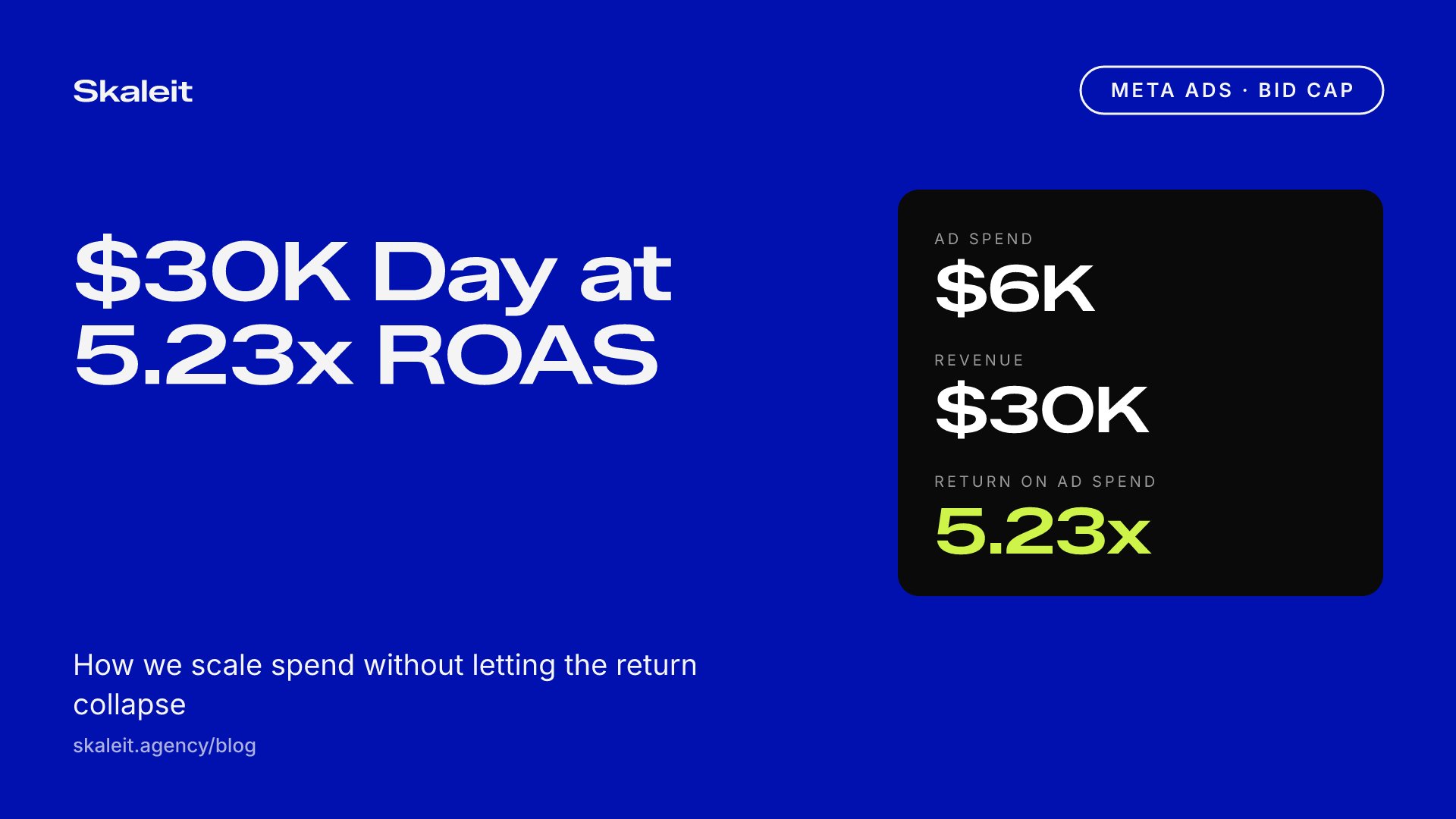
The Meta ads bid cap strategy is a way to increase spend on an ad account by moving proven winning ads into a manual bid campaign, where the bid cap is the maximum bid Meta is allowed to enter the auction with on your behalf. On one day inside that campaign we spent $6K and made $30K in revenue, a 5.23 return on ad spend (ROAS). We had a promo running that day, so treat that number as the ceiling and not the average. On ordinary days the same campaign lands closer to a three to four times return, depending on how much the bid cap campaign is spending.
Most ecommerce brands hit the same wall. Spend goes up, cost per acquisition (CPA) climbs past break even, profit collapses, and the account stalls. We started testing this structure one to two years ago and now run it in every account we manage, across supplements, skincare, clothing and toys. What follows, as of 2026: what a bid cap actually controls, how it differs from a cost cap, the formula that sets your first cap, which ads are allowed inside, what to do when the campaign will not spend, and how to budget and scale it.
TL;DR
- Bid cap is an auction bid, not a CPA ceiling. If you bid 50, Meta can still buy purchases at 20, and it will mostly stay out of auctions that would cost 70.
- One formula sets the cap. Max CPA equals average order value (AOV) divided by target ROAS. A $60 AOV at a 3x target gives you a $20 bid cap, not a round number you like.
- Only proven ads go inside. At least 50 purchases on the single ad, real engagement, and a launch to date frequency under 1.3 to 1.4.
- Duplicate using the post ID. The same asset then collects engagement from every campaign at once, which lifts the bid cap campaign and the test and scale campaign together.
- If it will not spend, raise the cap 5% at a time. Never more than 20% above your max CPA. If it still will not spend at that point, the creative cannot hold the cost and you need new ads, not a higher bid.
- Set a high budget on purpose. Five times the daily spend you already run, never less than five times the bid. The campaign will not spend all of it, and that is the point.
- Bid cap and cost cap run side by side as of 2026. Bid cap holds the proven top of funnel winners, cost cap carries the same winners plus the middle and bottom funnel ads that complete the sequence.
What Is a Bid Cap in Meta Ads?
A bid cap is the maximum bid you are willing to enter an auction with. Win the auction, get the purchase. The higher the bid, the higher your chance of beating other advertisers, and Meta will mostly not enter auctions above your bid. Set a bid of 50 and Meta can hand you purchases at 20, but it will not buy one at 70, because you are not bidding more than 50.
That is the whole misunderstanding in one sentence: a bid cap is not a cap on your cost per purchase. In one of our campaigns the bid was 23 and the average cost per purchase across roughly a month came in at 17, on 100k in revenue at a 3.25x return. The bid was the permission to enter more auctions. The cost settled well below it, because the bid is only one of three things Meta looks at.
The second misunderstanding is the budget. People set a tight daily budget and a tight bid cap together, then wonder why the campaign barely moves. The two controls work in opposite directions. The cap is the safety, so it stays at your maximum CPA. The budget is the room to run, so it goes far higher than you expect to spend.
How Meta Picks the Winner of the Auction
The auction is not won by the advertiser with the highest bid. Meta ranks ads by total value, and your bid is one input into that number. The advertiser bid is the part you control, and a bid cap campaign is the only place you set it by hand. In a highest volume campaign you let Meta pick it for you.
The estimated action rate is the likelihood that an impression shown to this specific person leads to the result you optimised for, so on a purchase campaign it is the probability that this person buys, estimated from the data the ad has already produced over past weeks or months. These two multiply, which is why even a small lift in the estimated action rate moves total value a long way.
The third input is the consumer experience, and it is the one most advertisers ignore. Meta is judging how interesting the ad is to the person it is about to be shown to, and quality here is not visual polish. It is engagement. Watch time on a video, time spent reading the primary text of a static, likes, comments, shares. This is also why Meta sometimes pours budget into an ad you think is weaker, that ad is carrying the engagement signal, and why an ad with obvious potential can get no spend inside a campaign budget optimisation (CBO) campaign next to a bigger winner.
Bid Cap vs Cost Cap in Meta Ads
A lot of advertisers use the two words as if they were interchangeable, and most people have the risk backwards. A cost cap is a result target, the CPA you tell Meta to aim for, and Meta delivers purchases while keeping the average cost per result near that number over a longer window. Set a cost cap of 100 and you can watch day one come in at a 200 CPA, day two at 20, day three at 60, day four at 120. Over 7 days or a month Meta works the average back toward the target.
| Bid cap | Cost cap | |
|---|---|---|
| What you set | The maximum bid to enter an auction | The average cost per result you want |
| Time frame | Auction by auction | Averaged over 7 days or a month |
| Control on a single day | Tight, Meta cannot chase expensive auctions | Loose, a single day can run far above target |
| Which ads go inside | Proven top of funnel winners only | The same winners plus middle and bottom funnel ads |
| Risk | Lower, it refuses the expensive days | Higher, it spends through them to hit the average |
| Job in the account | Spend hard on the days auctions are cheap | Steady acquisition and a complete funnel sequence |
Since the middle of 2026 we run both at the same time in the same account, because the jobs are different. The bid cap campaign holds the proven unaware, top of funnel winners and maximises profit on the days and periods when auctions are cheaper. The cost cap campaign holds those same winners plus the middle and bottom of funnel ads that produce great returns but will never scale to colder audiences, which is what completes the sequence. We also run a cost cap lane for creatives that get zero spend in the main CBO, to see whether they can bring purchases at the target cost. We covered that side separately in how to use Facebook ads cost cap to scale with high ROAS.
For this one job, spending more on the days the auction is cheap without handing Meta the chance to overspend, the bid cap gives tighter control. That is why we set a very high budget on it and let it take only the days it can take.
Which Ads Can Go Into a Bid Cap Campaign
A bid cap campaign only works with winners, and winner here has a definition. At least 50 purchases registered on the single ad, so there is real historical data behind the estimated action rate. Genuine engagement, a lot of likes and positive comments, with you replying to them. And a low frequency, meaning launch to date it still sits under 1.3 to 1.4 as of 2026. An ad between 1.5 and 2 can still work when the engagement is exceptional, but under 1.5 is the top of funnel band, and reaching new people is the reason this campaign exists.
Bid cap scaling is a scaling tool, not a testing tool. It amplifies what already works, and feeding it nothing is the single most common reason a cap campaign sits at zero spend for two days and gets killed. Everything gets tested first in a test and scale campaign, a highest volume CBO or an ad set budget optimisation (ABO) lane when one winner is starving the new creatives next to it.
When you duplicate the winner, use the post ID. That way the copy inside the bid cap campaign is the same asset as the one in your test and scale campaign, so both collect engagement on the same post at the same time. The bid cap campaign performs better because the test and scale campaign keeps feeding the asset, and the test and scale campaign performs better because the bid cap spend adds more engagement, which lifts total value on both sides.
Engagement Farming, the Clean Version
Engagement farming is the part people skip because it looks like customer service. Reply to every comment on the ad. It raises the ad quality Meta considers in the auction and pulls your cost per mille (CPM) down. The detail that matters is how you reply. Do not leave a thank you, start a conversation. If someone writes that the product changed their routine and their skin is better after seven days, ask a question back, because then they get the notification and reply again on the same ad.
Then take the same post ID into a third campaign, a post engagement campaign, targeting existing customers only. If the product is good, they leave the strongest comments you will ever get, on the exact asset that is about to be shown to cold audiences inside your other two campaigns. Check first. Look at the comments you already have, and if 9 or 10 out of 10 are positive, go. If they are not, the problem is the product, and the ads are not the thing to fix.
The Top of Funnel Myth
People say bid cap campaigns only work on bottom of funnel or very aware audiences. It depends entirely on the frequency of the ad you duplicate. Duplicate an ad with a 4 or 5x frequency just because the ROAS looks good and yes, you are talking to the bottom of the funnel. Duplicate an ad still under 1.3 or 1.4 launch to date after 50 purchases and it goes to new, unaware, top of funnel audiences inside the bid cap campaign, as long as you exclude existing customers there.
How to Set Your Bid Cap
Everything starts with one number, your maximum CPA, which is the most you can pay to acquire a customer and still hit your target return. The calculation is deliberately simple. Max CPA equals AOV divided by target ROAS. If your AOV is $60 and your target ROAS is 3x, your max CPA is $20, because 20 times 3 is 60. That $20 is your starting bid cap, not a guess and not a round number that sounds comfortable.
Two things to get right before you use it. Your target ROAS is the return that makes you profitable after cost of goods, shipping and overhead, so set it from your margins rather than from what sounds good. And use the AOV that reflects new customer orders, because the blended number including returning customers flatters a campaign whose whole job is acquisition.
The Three Bid Levels We Use
The bid you choose is not your CPA target, even though you can set it to your CPA target to stay safe. They are not the same number, because the ad ranking equation can still win you the auction below your bid. Set a bid of 60 and you can still be buying purchases at 40. We use three levels, and they behave like three phases of the same ad’s life.
- Safe. Set the bid at your target CPA. You are then close to certain the purchases you get come in under target. This works with a clear winning ad, a lot of engagement and a low frequency, usually in the early phase after you duplicate it. An ad that came in with 50 purchases can run to 200 or 500 purchases here.
- Risky. Set the bid between your target CPA and your break even CPA. This is where you go when the ad stops performing in the safe option, because it cannot win more auctions at that bid and needs an extra bit to enter them, while it is still collecting engagement and the frequency is still low.
- Super risky. Set the bid between your break even CPA and your AOV. This is for a clear winner with 20K plus likes and 1K plus comments, where the CPA in the test and scale campaign is stable after spending 30 to 50k, and you want to push competitors out of the auction.
A cap above your max CPA is not automatically a mistake. It works when the creative has killer engagement, because engagement is what lets the ad win auctions below the bid you entered. In the account we pulled the earlier example from, the target CPA was 17 and we set the bid in the risky band, above target and under break even. The campaign started spending more, which was the objective, and the cost per purchase stayed where we wanted it. A high bid is not a promise to pay that much, it is permission to enter more auctions.
When the Bid Cap Campaign Does Not Spend
This is where most bid cap campaigns die, usually after two quiet days. The campaign is not broken, it is telling you that at the bid you entered it cannot win enough auctions. There is a loop for it, and the only rules are that you wait 7 days between changes and you never let the cap drift more than 20% above your max CPA.
Start with the cap at your max CPA and the budget high. Then read the spend. If the campaign spends more than 90% of the daily budget at or under your target CPA, the budget is the thing holding it back, so raise the budget and leave the cap alone. If it spends part of the budget, say 20 or 30% of it, raise the cap by 5% and wait 7 days. Keep going in 5% steps until it clears 90%, or until you reach 20% above your original cap, which on a $20 max CPA means $22 and no further.
If it spends nothing at all, raise the daily budget by 20% first and check again, because a budget that is too small for the bid is the more common cause. If you end up at 20% over the cap and the campaign still will not spend, or it spends but the CPA lands above target, you have your answer: the creatives cannot sustain that cost. The fix is new tested ads added into the same ad set, the cap reset to your original target, and the loop started again. It is not a higher bid.
A real one, on a supplement account. The first cap was $25 and Meta spent fast at a $34 CPA, well above target. We dropped it to $20 and the campaign basically died, $11 in a day. We tested $23 and Meta started spending the full budget at a $16 CPA, then $2K to $4K a day at 3.27x. That $3 gap between $20 and $23 was the entire difference between a dead campaign and a printer. From there the work is budget, not bid. We walked through the same loop on video in the bid cap strategy we use to scale without the ROAS drop.
Budget and Scaling Rules for the Bid Cap Campaign
The structure is one CBO bid cap campaign per product, one ad set, winners only, existing customers excluded, because the job of this campaign is new customers. In our accounts that ad set holds 10 to 15 winners per product, and it will take anywhere from 6 to 50 of them. It sits next to the test and scale campaign for the same product, never instead of it, and we keep the Meta labels because they describe what each one is actually doing.
Then set the budget high. Usually five times the total daily budget you are actually spending, and at minimum five times the bid you entered, which is the starting point that tested best for us. Five to ten times your expected daily spend is the working range. You can start slower to see how it behaves, but the campaign is supposed to have more budget than it will use. It might spend 80% of it, or 70%, or 50%, and that is fine. Anything above half the daily budget at target return is a working campaign.
Scaling this campaign does not follow the 20% rule. You can go from 100 to 500, then 1,000, then 2,000. On one bid cap campaign we went from 500 to 3k in a single day, a 3k total increase, and it held, because the campaign is not obliged to spend like a highest volume campaign. We took one account from $100 a day to $2,000 a day at a 4x ROAS on this logic, another from barely spending to $12,000 a day, and we used the same manual bid lane when we scaled VYNEHERB from $30K a month to $250K a month.
Then leave it alone. Once the cap is found, the campaign will spend more on the days your product has more demand, which for a lot of brands is the weekend, and less on the others. It spends more when CPMs drop, the week after Cyber Monday or a slow period for your competitors, and it protects margin automatically when CPMs spike. Some days it does $500, some days $1,500. That is the campaign matching the auction instead of a human guessing at it, and it is the reason the month comes out with the highest profit the account could produce rather than the highest revenue on the best single day.
Related Results From Skaleit
To see where this kind of scaling ends up, look at how we took an account from 68K to 1.8M a month in revenue with a 9.85x ROAS. For the structure around it, read the Meta ads structure that works in 2026, our brutally honest advice to profitably scale your Meta ads, and why ROAS drops when you scale ads.
FAQ
Is a bid cap a cap on my cost per purchase?
No. A bid cap is the maximum bid Meta enters the auction with on your behalf, not a ceiling on your CPA. Set a bid of 50 and Meta can deliver purchases at 20, because the other inputs in the ad ranking equation can win the auction below your bid. In one of our campaigns the bid was 23 and the average CPA came in at 17.
What bid cap should I start with?
Your maximum CPA, which is your AOV divided by your target ROAS. A $60 AOV with a 3x target gives a $20 cap. Use the AOV of new customer orders, and set the target ROAS from your margins after cost of goods, shipping and overhead rather than from what sounds good.
Why is my bid cap campaign not spending?
Almost always the cap is too low for what your creatives can currently win, or the daily budget is too small for the bid. Raise the budget 20% first, then the cap in 5% steps with 7 days between changes, and stop at 20% above your max CPA. If it is still quiet there, the ads cannot hold that cost and you need new tested creatives in the ad set, not a higher bid.
What is the difference between bid cap and cost cap on Meta?
Cost cap is a result target, the average cost per result Meta works toward over a longer window like 7 days or a month, so single days can swing from a 200 CPA to a 20 CPA against a cost cap of 100. Bid cap controls the bid auction by auction, which is why it gives tighter control on a single day. We run both, with the bid cap holding the proven top of funnel winners.
What budget should I set on a bid cap campaign?
Set it high on purpose. We use five times the total daily budget the account is already spending, and never less than five times the bid, with five to ten times your expected daily spend as the working range. The campaign will often spend 50% to 80% of it, and that is the intended behaviour.
Which ads can go inside the bid cap campaign?
Only proven winners. At least 50 purchases registered on the single ad, strong engagement in likes and positive comments, and a launch to date frequency still under 1.3 to 1.4. Duplicate them by post ID so the copy inside the bid cap campaign is the same asset that is already collecting engagement elsewhere in the account.
Want This in Your Account?
If your spend is capped because the return falls apart every time you push the budget, get in touch with us and we will look at your account before the first call.