

ABO vs CBO is one budget setting in Meta Ads Manager. With ABO, ad set budget optimization, you set the budget on every ad set yourself. With CBO, campaign budget optimization, you set one budget at the campaign level and Meta decides how much each ad set gets. ABO buys you control and a clean read on every concept you test. CBO buys you Meta’s forecasting and far less daily management. Neither one is the answer on its own, and as of 2026 the accounts we run use both, for two different jobs.
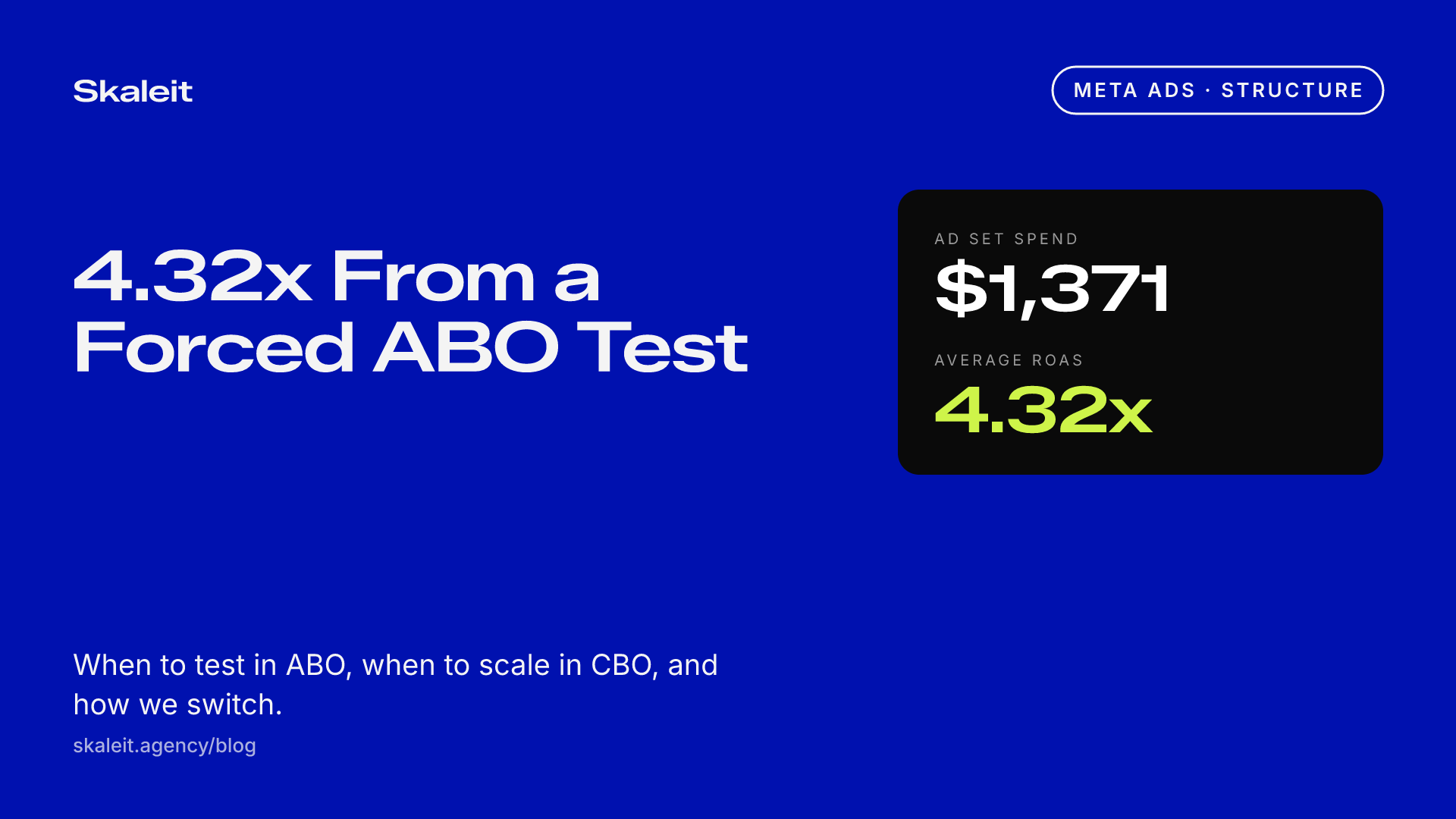
We manage more than $3M a month in Meta spend across 70+ ecommerce brands, and this is still the question that comes up on almost every first call. The short version of what changed this year: CBO is our default starting point, one campaign, one ad set per persona, 30 to 50 creatives inside, winners pulled out by post ID. ABO came back as a standing tool for one specific job, forcing spend into new creatives when a single winner is eating the entire campaign budget. On one account, moving the starved creatives into their own ABO ad sets produced 4.32x average ROAS on $1,371 of spend, a result those creatives were never going to reach sitting next to the winner. Below is what each setting does, when we pick which, and how we scale out of both.
TL;DR
- ABO puts the budget on the ad set. You decide what every ad set spends, so every concept gets a real test whether Meta believes in it or not.
- CBO puts the budget on the campaign. Meta forecasts which creatives are likely to perform and moves the money there before it is spent.
- CBO is our default. One campaign, one ad set per persona, 30 to 50 creatives, winners moved out by post ID once they are proven.
- ABO is the forced test lane. When one winner starves every new creative, the same creatives in ABO ad sets returned 4.32x average ROAS on $1,371 of spend.
- Scaling happens outside the test campaign. Proven winners with 50+ purchases and frequency under 1.5 go into a bid cap campaign, the rest of the winners into cost cap.
- There is no universal structure. We run four of them, picked on daily spend, SKU count, and how much testing rigor the brand needs.
- Judge winners on incremental attribution. An ad with a strong front-end ROAS carried by existing customers will stall the moment you scale it, in ABO or in CBO.
What ABO and CBO Mean in Meta Ads
ABO stands for ad set budget optimization. The budget lives on each ad set, and Meta has to spend what you allocated there, whatever it thinks of the ads inside. Five ad sets at $100 a day will each spend roughly $100 a day. That is the whole point of ABO: you are buying data on concepts Meta would never have funded on its own, and you accept that some of that budget goes to losers.
CBO stands for campaign budget optimization. In Ads Manager you will now see it labelled Advantage campaign budget, which is the same setting under a newer name. The budget sits on the campaign and Meta distributes it across the ad sets in real time, based on which ads it forecasts will produce results at the lowest cost. You keep more of your budget on the creatives that are working, and you lose visibility on the creatives Meta quietly refuses to fund.
Both terms describe budget placement only. They say nothing about targeting, bidding strategy or creative volume, which are the three settings people usually blame when an ABO or a CBO campaign underperforms. ROAS, return on ad spend, is what you are ultimately reading in both cases, but the two setups hand you very different data to read it with.
ABO vs CBO: The Difference in One Table
The trade is the same at every spend level. ABO gives you clean variables and more work. CBO gives you efficiency and a blind spot.
| What changes | ABO (ad set budget) | CBO (campaign budget) |
|---|---|---|
| Where the budget sits | On every ad set | On the campaign |
| Who splits the spend | You do, in advance | Meta does, in real time |
| What you get | A read on every concept you funded | Budget concentrated on likely winners |
| What you give up | Budget spent on ads that fail | Sight of what Meta will not fund |
| Ad sets to manage at $50K a month | 20 to 50 | 3 to 5 |
| Best job | Forcing a test that would not happen | Finding and feeding winners |
That management gap in the last two rows is the part nobody prices in. An ABO setup at $50K a month can mean 20 to 50 ad sets to monitor, edit, document and revisit every few days. The same spend in CBO is usually 3 to 5 ad sets, because Meta is doing the allocation. The hours you get back go into creative production and offer building, which is where most of the performance actually sits.
ABO or CBO for Testing? What We Run in 2026
Our default starting point is a single CBO: one campaign, one ad set per persona, 30 to 50 creatives inside, and winners moved out by post ID once they are proven. That is a default, not a law. The reason it tests well post-Andromeda is that Meta learns at the creative level and aggregates that learning at the ad set level, so the more creatives sit inside one ad set, the more signal Meta has to work with. Splitting the same creatives across many ad sets fragments that signal and puts your own ad sets into the same auctions against each other. We broke the full setup down in our post-Andromeda ads testing structure.
CBO testing has one specific failure mode, and it is the reason ABO came back. When one creative in the campaign has months of spend, purchases and comments behind it, Meta routes the budget to it and every new creative you add starts at zero engagement and never gets enough spend to prove anything. The campaign looks healthy and the pipeline of new winners quietly dies. This is the same mechanic behind Meta spending your budget on the worst ads, read from the other direction.
The fix we now run is to relaunch those starved creatives in an ABO campaign, one ad set per concept, with the budget forced. On one skincare account, those forced ad sets came back with ROAS between 2 and 4 and a 4.32x average on $1,371 of spend, well above the account target. Once a creative there has engagement behind it, we graduate it back into the CBO or into a scaling campaign by post ID, so the social proof travels with the ad instead of resetting.
Some accounts simply run better in ABO permanently, usually when the brand needs every angle tested on purpose rather than tested if Meta feels like it. The reverse is also true: brands under roughly $2K a day with one hero product rarely need ABO at all, because there are not enough ad sets in the account for a winner to starve anything. The decision is about the account in front of you, not about which setting is better.
How to Scale: Moving Winners Out of ABO and CBO
Whatever you test in, scaling is a separate campaign. Winners sitting inside the test campaign starve every new creative next to them, so moving them out is what keeps the test campaign functioning as a test campaign. Always duplicate by post ID rather than uploading the creative again, because the likes, comments and shares carry over and the ad keeps its engagement advantage in the auction.
The bid cap lane holds the proven top-of-funnel winners: 50+ purchases, frequency below 1.5, and strong engagement. A bid cap is the maximum bid Meta enters the auction with on your behalf, not a ceiling on your cost per purchase. You can bid high to win auctions and still come out at a much lower cost per purchase, which is why a cap set above your target CPA can still work when the creative has real engagement behind it. We covered the mechanics in our risk-free bid cap scaling strategy.
The cost cap lane sits next to it and does a different job. Cost cap is an average cost per result target over a longer window, and because Meta works on a 7-day click attribution window the campaign needs time before the number settles. It spends more freely than bid cap and carries more risk. We use it for the single best performer plus a rescue lane for winning creatives that get zero spend in the main CBO.
One warning that applies to both settings. Before you promote anything, check who the purchases came from. An ad showing a strong ROAS on the front end can be living off existing customers, and that ad will hit a wall the moment the budget goes up. Filter by audience and judge on incremental attribution, not on the ROAS column, because Meta is lying about your winning ads, or you will scale an ad that was never scalable.
The Four Structures We Run for Clients
Across the portfolio, four structures cover almost every scenario. Each one fits a spend level and a tolerance for wasted testing budget.
1. ABO test plus CBO scale
The classic separation. An ABO testing campaign with one ad set per concept, persona or angle, and winners duplicated by post ID into a single ad set CBO scaling campaign. Use it when you have the budget to test angles cleanly and you want maximum control over what gets scaled. Keep one bidding strategy across the whole flow, mixing them inside the same logical setup usually breaks delivery.
2. One campaign, one ad set, test and scale together
The simplest possible structure. One CBO, one ad set, every creative inside. This works very well for brands spending up to $1K to $2K a day, especially single-product brands or brands launching one product at a time. You can duplicate the structure per product so each product gets its own test-and-scale campaign. The risk is that Meta turns off creatives with a low ROAS that are actually driving incremental sales, so read the data below the ROAS column.
3. One CBO, multiple ad sets
One CBO campaign, several ad sets, each holding a creative batch grouped by persona, angle or concept, and you scale by lifting the campaign budget. Split the ad sets by persona and angle rather than at random, cleaner signals at the ad set level still help Meta consolidate learning. Use it when you have enough creative volume to populate 3 to 5 ad sets properly.
4. Multi ad set CBO test plus single ad set CBO scale
The same as structure 3 with a dedicated scaling campaign on top, holding the post IDs of every winning ad. You get explicit control over how much budget pushes into proven winners without giving up consolidated testing. Use it when you are spending $5K+ a day, and pick the bidding strategy on the scale campaign: highest volume for aggressive growth, cost cap or bid cap when you need tighter guardrails.
How to Pick ABO or CBO for Your Account
Two questions decide it. How much testing rigor do you actually need, and how much complexity can your team manage at your current spend? A practical starting grid from the accounts we run:
- Under $2K a day, one hero product: structure 2, one campaign, one ad set, test and scale together.
- $2K to $5K a day, several SKUs: structure 3, a multi ad set CBO scaled at the campaign level.
- $5K+ a day and you need testing rigor: structure 1, ABO test into a CBO scale.
- $5K+ a day and you want consolidated learning plus control: structure 4, multi ad set CBO test into a single ad set CBO scale.
- Any spend level where one winner is starving your new creatives: add an ABO forced test lane on the side, whatever else you run.
These are starting points, not rules. We have brands that break every one of them because their offer, their margin or their SKU mix changes the math. Anyone selling you the one structure that works is selling you their structure, which worked on their account.
Related Results From Skaleit
For a worked example of this approach on a real account, see how we scaled Skin Design London, a UK luxury skincare brand. If you want the settings rather than the theory, the only Meta ads structure that works in 2026 walks through the bid cap and CBO pairing, our Facebook ads testing strategy to explode your ROAS breaks down the four structures in more detail, and our advice on how to profitably scale your Meta ads covers what to do once the winners are out of the test campaign.
FAQ
What does ABO mean in Meta ads?
ABO means ad set budget optimization. The budget is set on each ad set, so Meta has to spend what you allocated there regardless of how it rates the ads inside. It is the setting you use when you want every concept funded on purpose.
What is the difference between an ABO campaign and a CBO campaign?
Only the budget placement. In an ABO campaign each ad set carries its own budget and you control the split. In a CBO campaign one budget sits on the campaign and Meta moves it between ad sets in real time based on which ads it forecasts will convert cheapest.
Is ABO or CBO better for testing?
CBO is our default for testing, because Meta forecasts likely winners before spending and you keep more budget on creatives that work. ABO is better when one proven winner is absorbing the campaign budget and new creatives cannot get enough spend to prove anything. As a rule of thumb, budget $200 to $500 per ad set for an ABO test.
Can you run ABO and CBO in the same account?
Yes, and as of 2026 that is what we do on most scaling accounts. The main CBO tests and feeds winners, an ABO campaign forces spend into creatives that would otherwise be starved, and bid cap or cost cap campaigns hold the proven winners.
How do I scale a winner out of an ABO test?
Duplicate it by post ID into the campaign that will scale it, so the existing likes, comments and shares carry over. Winners with 50+ purchases and frequency below 1.5 go into the bid cap campaign, other winning ads go into cost cap or back into the main CBO ad set.
How many ads should sit in one ad set?
Between 12 and 50, depending on the daily budget behind the ad set. Our default CBO ad set runs 30 to 50 creatives across the awareness stages, while a bid cap or cost cap scaling ad set holds only 10 to 15, because those hold proven winners only.
Want This in Your Account?
If one winner is eating your campaign budget and every new creative you launch dies at $20 spent, get in touch with us and we will look at your account before the first call.